Jun 27th, 2026 Saturday Cloudy
Overall, I am a risk averse person.
While this does not mean that I always follow the safe route – every now and then I do want a little adventure – when it comes to decisions whose outcome can be easily measured in an objective way (e.g. investment), I am unwilling to bet my fortune on something that has an unknown chance of turning out badly. Even for cases where the probability of unfavorable outcome is shown to be, on average, fairly low, the huge swings (up and down) still make me nervous. Clearly, day trading is not for me 😛
That is not inherently problematic. In fact, the real loss is opportunity cost, i.e. what I could have gained had I chosen the riskier option. However, that loss is usually not salient – one may never know what one has missed because one did not have the chance to experience it to begin with. In other words, ignorance saves the heartbreak.
Except in games (at least the well-designed ones), where the impact of every choice could be plainly felt and evaluated.
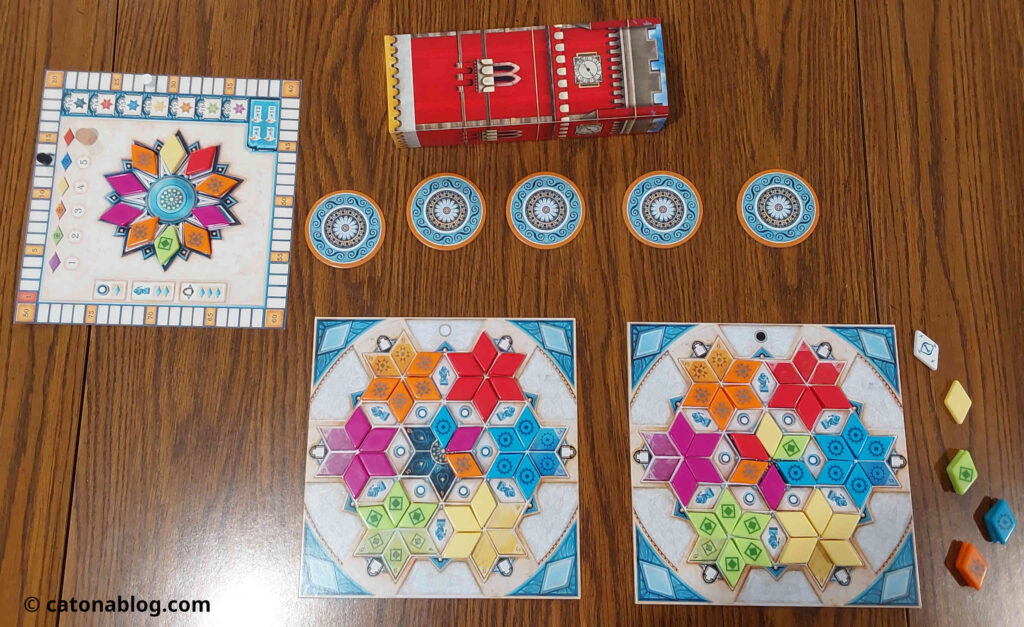
My recent sessions playing Azul – Summer Pavilion have reminded me of this weakness (to a certain degree) of my own inclination.
This game has a tile-laying mechanism, similar to the first version of the same product line. I understand that winning is not simple, so after a devastating defeat by my husband (completely expected yet equally upsetting), I set out to try the solo variant, in the hope of finding a way to conquer it. Despite unable to claim victory, the process of placing beautifully crafted tiles onto artistically designed “window” boards is nonetheless quite appealing.
My first attempt in solo mode was even worse. The dummy player (Automa) seemed to have an insurmountable advantage in every round, quickly scooping away the majority of “shingles” and completing the “flowers” (hexagonal shaped panes) at an alarming rate that left me scratching my head to keep up. I did not even have the heart to finish the final scoring as the result was so obvious 😭
At that moment, I realized that I must change my strategy. How?
Upon reflection, I noticed that Automa prioritizes taking the first-player token regardless of the negative points it would receive (one point for every tile you take together with the token), sometimes that could be as high as minus five! Nevertheless, instead of putting it at a disadvantage, this step must have granted enough benefits (e.g. being able to fill more “petals” and preventing your opponent from doing so) so the net effect is definitely positive.
Having done my own reasoning and analysis, I pushed myself to accept the apparent penalty by aiming to get the first-player token as much as possible. To my surprise, this minor adjustment has seemingly tipped the balance of the competition. I even managed (without intending to) to foil Automa in one round such that it was unable to complete any section! In the end, I won by fifteen points with a total of 128 🙂 It was very satisfying.
The risk is worth taking. At least, I learned that it must be an option worth considering, whereas previously I ruled it out from my mental space due to the uneasiness of giving away my earned points. Summoning the courage to walk out of one’s comfort zone does pay off, a lesson that I will hope to remember in life in general.