Jun 21st, 2026 Sunday Cloudy
The Dragon Boat Festival has just passed.
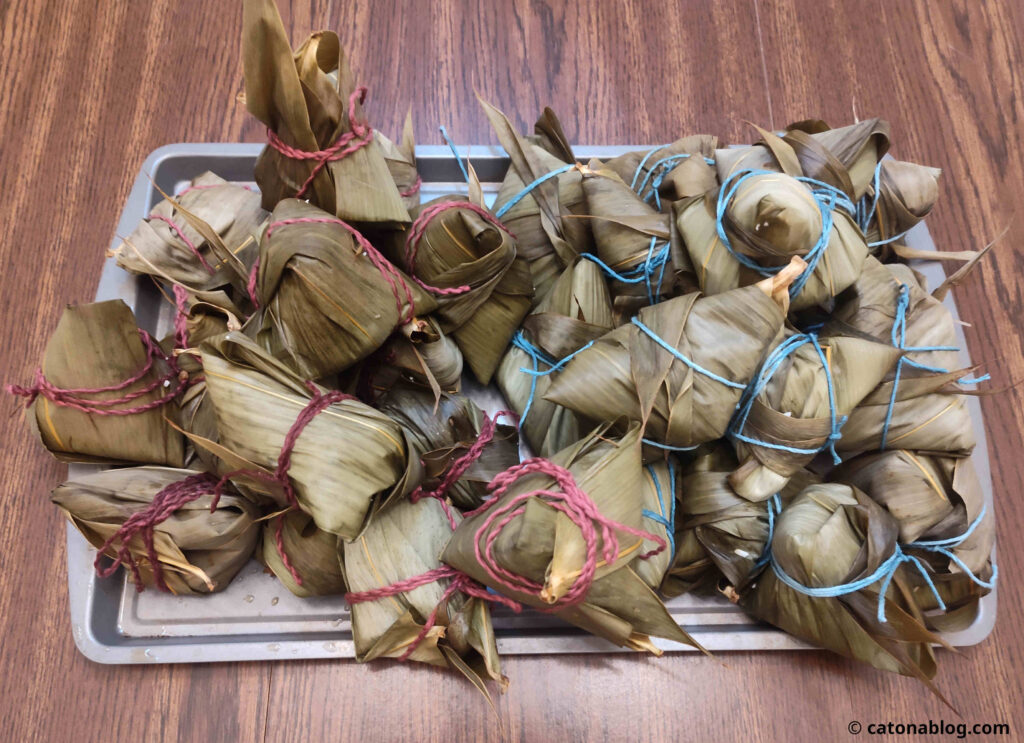
Not living in a city where that would be a big deal, my husband and I usually celebrate it by devouring some zongzi, a traditional food of boiled sticky rice and stuffing wrapped in leaves. If we are in the mood and can spare the time, we make a batch ourselves; otherwise, we are satisfied with purchasing some.
This year, the festival, which falls on May 5th by lunar calendar (so the actual date shifts), happens to coincide with Juneteenth, so we both took the day off work. This allowed us some leisure to prepare zongzi, as neither of us is very confident in this process and definitely prefer not to do it under time pressure.
To get some inspiration, I watched a video from a Taiwanese blogger couple, whose casual and humorous style often provides me with good laughs and moments of relaxation.
In this video, the blogger couple decided to experiment with foods normally not found in zongzi, like frozen dumplings and radish cakes. Moreover, they were not using these as filling (sticky rice is the base of zongzi, and various fillings CAN be added, though some people claim that plain ones with nothing else are the best), but the “body” of zongzi. How?
Basically, they cut up the chosen ingredient to resemble the texture of sticky rice, fold it the same way as a typical zongzi, and add a whole piece (e.g. ONE entire dumpling) as the filling. Then the finished product gets cooked and tasted. Quite a few turned out nicely (at least according to the bloggers), with potential to become the next trend.
How interesting!
As I was marveling at their creativity, it occurred to me that I have rarely seen such novelties here. The ones carried by Asian grocery stores tend to be the most common kind, i.e. sweet ones with red bean paste, savory ones with barbecue pork, shiitake, and a salted egg yolk. Likewise, for other specialties associated with specific holidays (e.g. mooncakes for Mid-Autumn day), the most “old-fashioned” flavors are the mainstream, with “new” fads hard to come by.
Why is that?
I wonder, whether this is a manifestation of nostalgia.
For immigrants that are separated from their homeland, eating is an important way of reconnecting with one’s past. Naturally, the traditional foods that have been passed down many generations are imbued with the cultural significance, as well as our memories of the home culture – childhood spent with extended family, meals enjoyed while listening to the folklore, the views of parents bustling in the kitchen.
The newly invented “fashion”, however innovative, always feels like something is missing. Maybe worth a try every now and then, but unlikely to become a mainstay.
Perhaps, only in a foreign soil, the desire to hold onto one’s root is particularly strong.