May 1st, 2026 Friday Cloudy
We cook a lot at home.
On the surface, cooking sounds like a single activity. In reality, it is a fairly involved process: you have to decide on what to cook, when to cook, gather all the tools and meats/vegetables before cooking, and have a plan for the outcome of cooking (e.g. will you eat the food right away? Will you share the food? If any is left, how do you pack it?). Figuring out a way to make it sustainable with as little stress as possible is a big part of “adulting”.
As anyone familiar with my style would confirm, I am a planner. Naturally I started making meal plans as soon as I moved into an apartment. When my now-husband became my roommate, the meal planning became an important component of our relationship. After all, we sat down to enjoy dinner together almost every day.
Being more particular about food, I am solely in charge of picking out recipes, for which I browse several sources, consider the cost of ingredients and our freezer inventory, take into account the proportion of meaty and vegetarian dishes, various proteins, time and energy required, and of course, the preferences of my husband and me.
At first, I compiled a record of things my husband loves and hates, and tried to score as many in the first category as I could and avoid any in the second one altogether. However, this quickly proves problematic.
To start with, some items my husband is not a fan of happen to be my favorites (e.g. yogurt, eggs, creamy texture). To strictly follow this practice means to give up plenty of dishes that bring smiles on my face.
Likewise, I also have quirks, thus my own list. Generally, if a dish features something I absolutely cannot tolerate, it will be crossed out as a candidate on our menu. So if I apply the same logic and only allow entrees that satisfy both of us, we would end up with a fairly restrictive diet.
I do not want that. Not only would it decrease the fun of experimenting new cuisines, a major draw of cooking, it is also unhealthy as consuming a large variety of foods helps prevent most food-related illnesses and malnutrition.
Therefore, I make an effort to be inclusive.
Consequently, on some nights the dinner is a highlight that excites my husband and me alike. On some other nights it is a more positive experience for one of us.
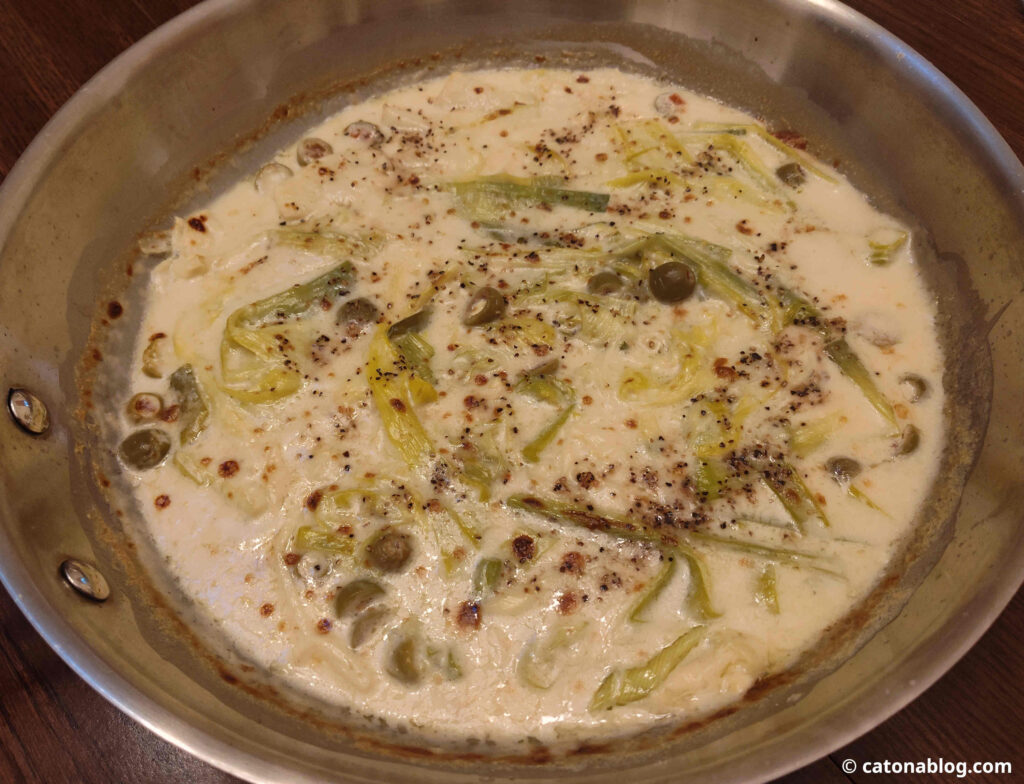
This Wednesday was a perfect example. I selected a Spanish leek gratin because I was curious how it would taste like, and according to the recipe, it was not complicated. I knew in advance that blue cheese (actually Cabrales, but I have no idea where to find that) was instrumental, and my husband detests just about any cheese.
It was a success, and he ate his portion without much complaint. To me, the sweetness of leeks shone through the rich cheese sauce, balanced by the pungent olives and crusty bread. I felt like savoring a tapas in a fancy restaurant, and I happily agreed to be responsible for the leftover.
Meanwhile, my husband prided himself for being indulgent on his wife, given that I also prepare his choices (not mine) every now and then.
It is with this give-and-take approach that a relationship thrives in the long run.