Feb 6th, 2026 Friday Sunny
For Christmas, I received a new board game as a present – let’s go! To Japan.
I have known about the game since it first came out, but I was surprised to be gifted it, especially from my husband. After all, he is the one who is always reluctant to initiate any vacation, even though he claims that traveling with me itself is fun 😛
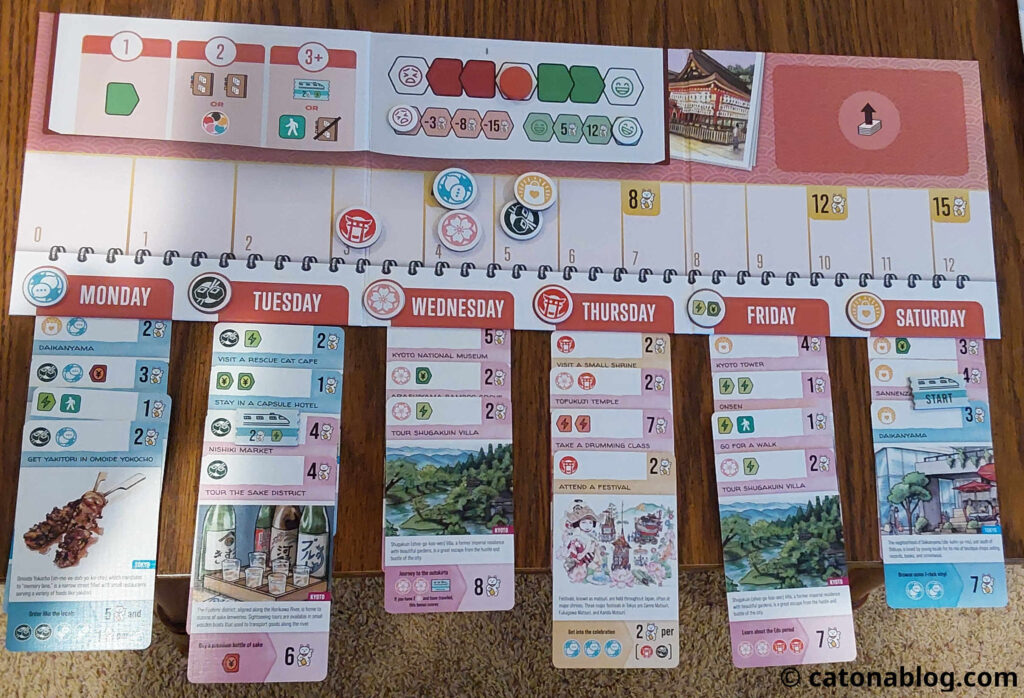
This is a game of designing a vacation in Japan – more precisely, in Tokyo and Kyoto. Throughout the course of thirteen rounds, you select from available activities to fill up your one-week-long itinerary. Different contents award you with different points, and you can earn bonuses by fulfilling highlight of the day (e.g. cook a complete kaiseki meal). Of course, every time the program you have chosen switches cities, you have to take the train – which magically consumes no time, but may deduct points (unless it is a luxury one) at the end.
I would say this is a reasonably realistic depiction of actual trip planning. After a few trials, I start to notice a pattern in the types of entertainment that I am inclined to pick, particularly if I am playing solo.
This is evident from today’s adventure, where I beat the dummy player 144 – 101. Looking at our boards, I realize that despite the final scores, my opponent had a fantastic vacation – she took a drumming class, stayed at a really nice hotel, and had a shopping spree in department stores in Ginza. In contrast, I rarely splurged, but visited shrines, temples, onsen, and many interesting spots instead. I won by having a relaxed, affordable vacation compared to her high excitement, high spending experience.
This turns out to be a core mechanism – the cards that either advance many experience tokens further on the tracker or grants many points tend to be either expensive or strenuous, adding a certain level of stress to the excursion. On the other hand, the ones that seem much less packed and more leisurely tend to bring happiness by either saving money or helping you unwind (e.g. visit a cat cafe – come on!).
Sure, for the solo version, this could very well be the result of my maneuvering – I prefer the second kind of schedule, so the tasks misaligned with my goal are often passed on. However, just like in real life, for a specific period on your journey, you can either buckle up and absorb all the stimuli, for the fear of missing anything, or sit back and savor the ride, fully and completely.
You cannot have both.
And there is not one “perfect” mode. There is not one “perfect” vacation. What suits you best depends on your style and your needs, at that moment.
When I played this game with my husband, I inadvertently alternated between the two modes, partly because I had less control over the cards available to me. What I ended up getting was a more balanced outline – a little bit of extravaganza here and there, offset by free sites and flee market hunt.
Perhaps, now that we understand that striving to maximize everything is impossible, we can take off some pressure when organizing our next memorable expedition.