Jan 30th, 2026 Friday Cloudy
I have been knitting for a while, but I would not think of myself as an advanced knitter. However, when I casually brought up this topic with someone at work, who also loves to knit and has been doing it since childhood, I was shocked to find that, by her standard, the type of knitting I do is “fancy”.
And the techniques in question are fair-isle and intarsia. Both can use colors to create stunning results, though the steps are really simple. Yet this got me thinking: for any skills, at which point does someone graduate from the beginner camp to become an intermediate, and what qualifies one to be an expert?
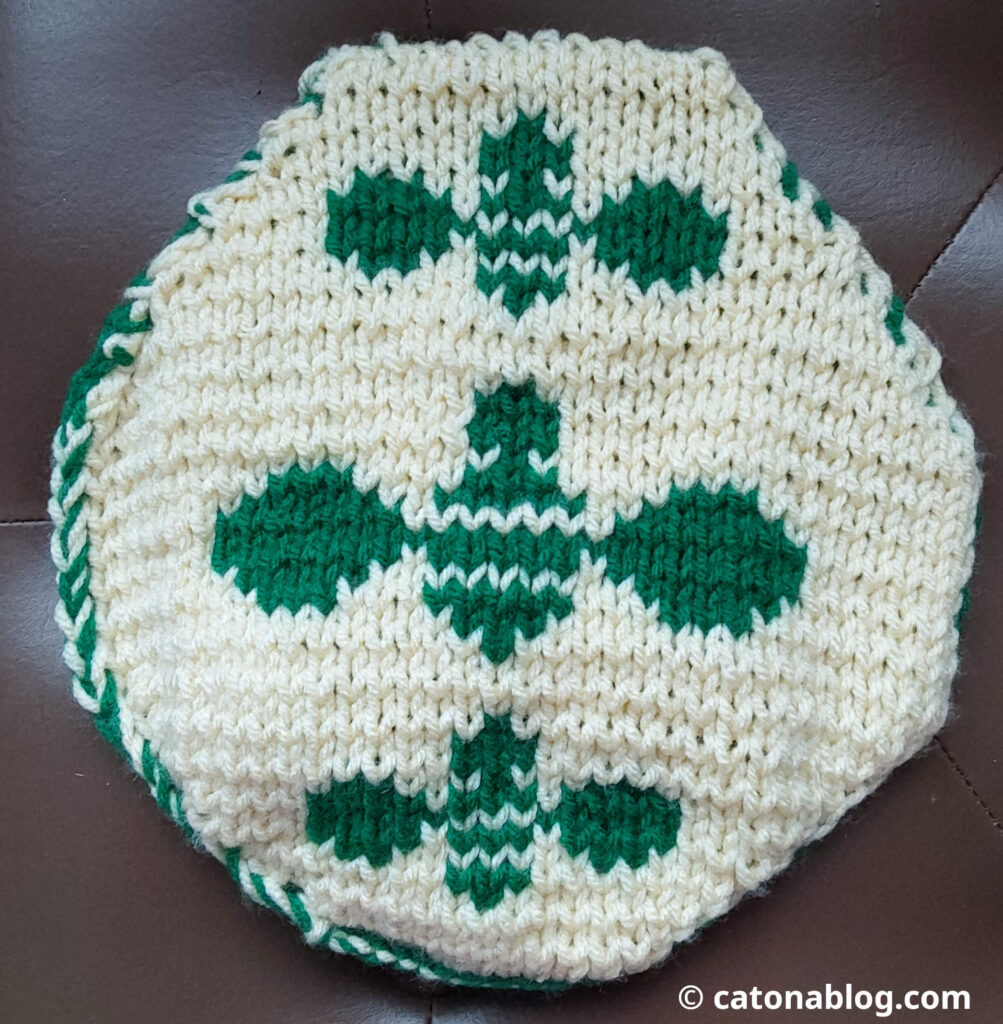
I recently started a project for a double-sided pot holder. I find double-knitting, where two colors depicting the same pattern are reversed on opposite sides of the work, very satisfying and appealing. While it is literally like making two products at the same time, the fact that the item could be enjoyed two ways seems to compensate for the seeming complexity.
There are a total of forty-eight rows. The first forty or so went smoothly, then at row forty-one, I paused.
My eyes told me that I must have messed up somewhere. The last bee floating against the background looked choppy. But I could not figure out why, how, or where something went wrong. What should I do?
I could carry on as normal, either naively believing that things would right itself in the end, or persuading myself that this is only a practice, and the outcome does not matter. The former is purely wishful thinking – in real life I have never seen it work out like that. The latter means continuing to invest more time and effort into an output that in all likelihood will not be used.
I could rip apart the whole thing and redo it from scratch. Even though I have done it in the past, usually only after a few rows in, the sunken cost at this stage felt too high. I know I would feel so discouraged that the yarns and needles would bear my grudge, even if I did pick them up again.
Eventually, I made a bold move. I decided to trace back to row thirty-six, which, not only did I feel confident that it was correctly executed, but I also knew how it should be set up properly for the next row.
It was approaching midnight by the time I completed the salvage. A couple days later, the finished piece lay on the table. It is not perfect – I can still improve on making the edges look neater – yet much better than what I would have (or not) had I chosen other alternatives.
At that moment, it occurred to me that the ability to troubleshoot when a task does not go as planned might be what distinguishes a novice and a professional. A true master can turn any disturbance into an opportunity, and create what is truly unique, memorable, and unreproducible.
Because in reality, if one can only walk the path that is laid out flat, with every process clearly marked and tested, one is just a mindless follower, not very different from a robot.
The aptitude to navigate the unknown, gracefully and successfully, defines the master. I am certainly not quite there. Nevertheless, I have launched on the journey.